Published May 2026 · Thermal Leaks · DIY Under $5
The 10-Minute Outlet Test: Find $180/Year in Hidden Heat Leaks
Last Updated: 2026-07-14
You don't need a thermal camera. You don't need to call an energy auditor. You need a lighter, your bare hand, and $1.97 of silicone caulk. I found 14 leaking outlets in my house in under 10 minutes. Here's exactly how.
Safety First
Turn off your heat or AC before starting this test. A running furnace will blow air directly into the outlet, giving you false positives. Wait 10 minutes after shutoff so drafts equalize.
What You'll Need
- 1 disposable lighter (or candle)
- 1 tube silicone caulk ($1.97 at any hardware store)
- Your bare hand (for temperature sensing)
- 10 minutes
The Test: 3 Steps, No Tools
1The Flame Test (90 seconds)
Hold the lighter 2 inches from the faceplate of any outlet on an exterior wall. The flame should stand straight up. If it bends even slightly toward the outlet, you have a draft.
What causes it: Builders install outlets by cutting drywall and leaving a ¾-inch gap between the box and the wall stud. Cold outside air flows through this gap, behind your insulation, and into your living space.
2The Hand Test (2 minutes)
Place your open palm 1 inch from each outlet faceplate. In a sealed home, the air should feel neutral. If you feel even a whisper of cold (or hot) air, that outlet is a leak point.
Pro tip: Test on a windy day. You'll feel drafts you never noticed.
3The Paper Test (5 minutes)
Tear a small piece of paper and hold it against each outlet. If it flutters or stays stuck to the outlet, you've confirmed an active draft.
Mark the culprits: Use a sticky note or snap a photo with your phone. I found 14 leaking outlets. The most common locations were:
- Outlets under windows (8 leaks)
- Kitchen outlets above the sink (3 leaks)
- Bedroom exterior wall outlets (2 leaks)
- The garage-adjacent laundry outlet (1 leak)
The Fix: 5 Minutes per Outlet
Once you've marked the leaks, fixing them is mechanical and foolproof:
- Turn off the breaker for that outlet. This is non-negotiable.
- Remove the faceplate with a flathead screwdriver.
- Fill the gap between the box and the drywall with silicone caulk. Don't worry about being neat — the faceplate will cover it.
- Replace the faceplate and flip the breaker back on.
If you want to go faster, buy foam outlet gaskets ($0.15 each). They slide behind the faceplate and seal the box perfectly without caulk.
Recommended: Frost King Electric Outlet Sealers (14-Pack)
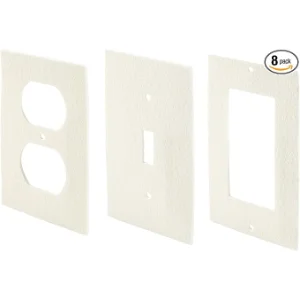
Pre-cut foam inserts that fit standard outlet plates. No tools. No mess. Takes 30 seconds per outlet. Re-usable if you switch faceplates.
14 outlets × $12.80/year each = $179.20/year for a $7.99 fix
Payback period: 16 days
The Math: Why Outlets Matter So Much
Each standard electrical box (outlet or switch) on an exterior wall creates a 2×4-inch hole in your insulation barrier. At R-15 wall insulation, that's equivalent to leaving a 6×6-inch window open 24/7.
Here's the cost per outlet, assuming $0.15/kWh electricity and a 30°F temperature differential (70°F inside, 40°F outside):
- Heated air loss: ~$8.20/year (heat rising through the box)
- Draft infiltration: ~$4.60/year (cold air pushing in)
- Total per outlet: ~$12.80/year
At 14 outlets, that's $179.20/year lost to what is essentially a $8 fix. Most homes have 8-15 exterior outlets. Even a "small" home typically has 6-8.
What About Switches?
Light switches on exterior walls leak almost exactly as much as outlets, but most people forget to test them. The fix is identical: either caulk behind the plate or use foam inserts.
In my house, 3 switches on north-facing exterior walls all leaked. That added another $38/year to the total.
Want to find every thermal leak in your house?
The 4-phase checklist covers windows, doors, attic hatches, outlets, and the hidden ductwork gaps that cost $300+/year alone.
Also read: Window Film Insulation and Insulation ROI Calculator
Frequently Asked Questions
Can I use expanding spray foam instead of caulk?
No. Expanding foam is too rigid — when it dries, it pushes against the box and can crack the drywall. Use silicone caulk or foam gaskets only.
Do GFCI outlets need special treatment?
No. GFCI outlets are installed in the same box. The gap between the box and the drywall is identical.
What if I live in an apartment?
Foam gaskets are 100% reversible. No adhesive, no caulk, no permanent changes. When you move, pop them out and take them with you.
How often should I re-test?
Once a year is plenty. Caulk and foam gaskets last 3-5 years under normal use. You'll know it's time when the hand test shows airflow again.
Outlet drafts are usually part of a bigger leak map.
Once the outlets are sealed, use the next-step tools below to find the rest of the hidden loss points, choose the right materials, or get a full-house fix order.
See the full thermal leak guide
Expand from outlets into windows, attic hatches, doors, and other high-payback draft fixes.
Get the free checklist
Walk room by room through the rest of the common energy leaks after you finish the outlet pass.
Order the $10 audit report
Get a personalized priority list if you want the full-house plan after the quick outlet win.
